Database & Query Engine Benchmarking

Measuring engines and protocols under controlled, cold-cache conditions. Every result ships with the experiment that produced it.

sqlbenchdag — a reproducible benchmarking laboratory

Every experiment is a capsule addressed by an 8-character SHA-256 fingerprint over its config, SQL, and every line of measurement-relevant Python. Change the method and the ID changes. Cold-cache execution, hard row-count assertions, and an integrity seal on every capsule. The four published Quack capsules additionally carry OpenTimestamps proofs anchored to Bitcoin.
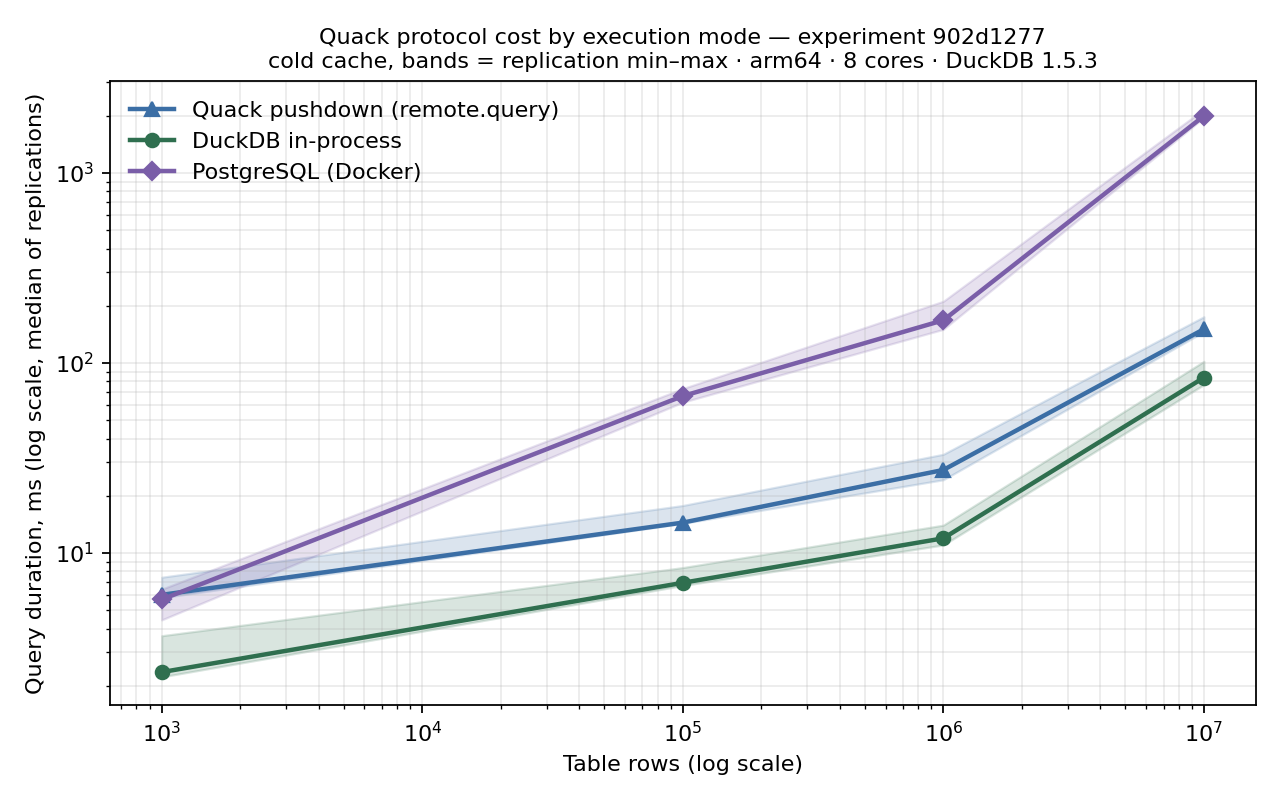
DuckDB-over-Quack vs PostgreSQL, query duration by table size
Capsule 902d1277 — DuckDB-over-Quack (pushdown) against PostgreSQL: 4.4× at 100K rows, 6.1× at 1M, 13.2× at 10M. Bands are replication min–max, cold cache, arm64, 8 cores, DuckDB 1.5.3. Caveat disclosed in the config: PostgreSQL pays a macOS Docker-VM tax on this bench.
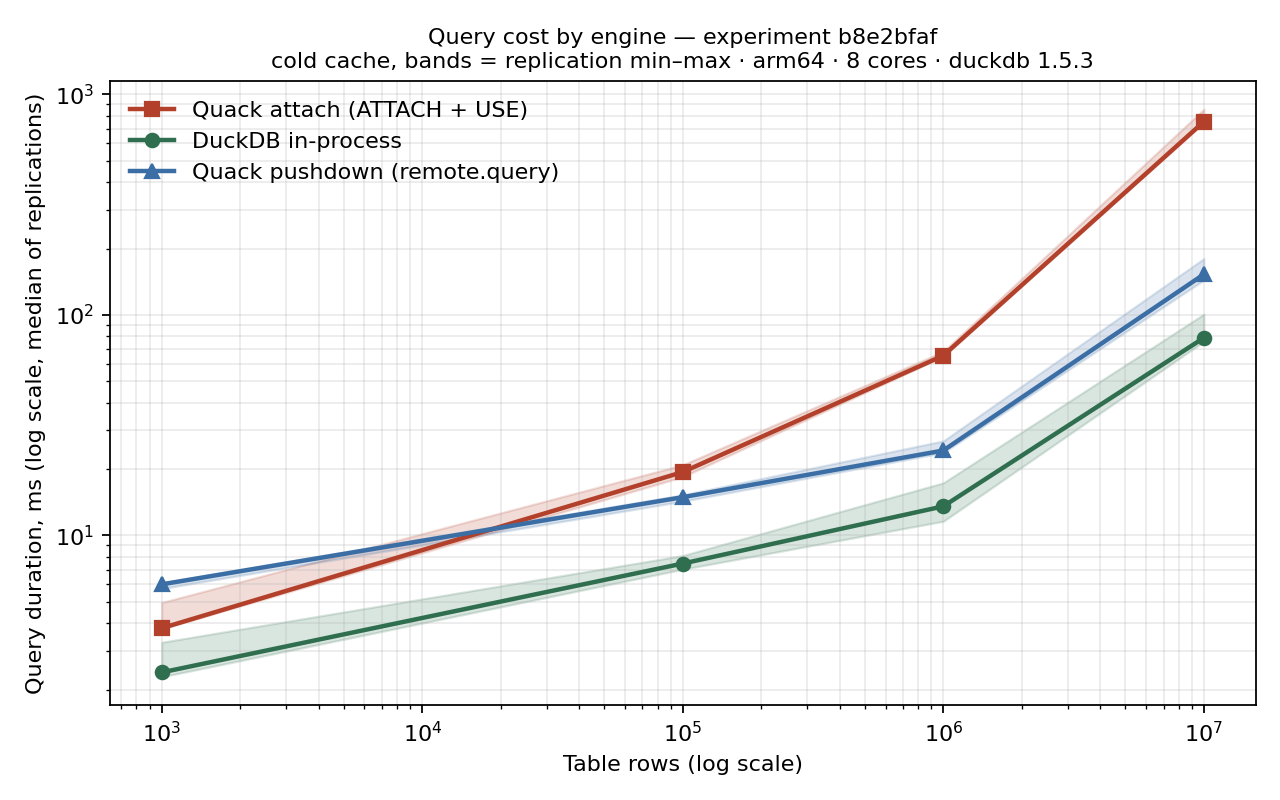
Quack attach mode vs pushdown vs in-process DuckDB
Capsule b8e2bfaf — attach-mode overhead grows with scan size (2.6× at 100K → 9.5× at 10M); pushdown stays flat at ~2×. Attach mode streams table data client-side; pushdown ships only results. The residual 2× traced to reduced server-side parallelism, not transport (capsule 25b0e134).
DagsterDuckDBPostgreSQLPolarsArrow / ADBCDockerPydanticMCP
MCP server published to the official registry — v0.1.2, 10 tools, active since 2026-08-10. Install with uvx sqlbenchdag.

Agent Memory Security

Attacks on what an agent stores and later treats as its own knowledge. Maps to OWASP LLM01 (indirect prompt injection) and LLM04 (data poisoning).

Semantic injection into agent memory

A deterministic exploit against an open-source agent memory system: text that reads as ordinary content to a human, but that the extraction pipeline turns into a stored fact the agent later treats as its own knowledge. Disclosed responsibly. Separately, a forensic read of a coding agent's local state directory — what it writes to disk, in plaintext, without telling you.

Agent memorySemantic injectionCoordinated disclosureForensics
Authorised researcher, Anthropic Cyber Verification Program.

Agent Evaluation & Reliability

Instrumenting agents and reading what they actually did, rather than asking them. Relates to OWASP LLM06 (excessive agency).

Reading agent traces

Per-turn tracing and deterministic grading of coding agents working against a commercial lakehouse platform. The traces surfaced three defects I reported upstream — including an error message that actively sends an agent in the wrong direction, suggesting tanh for a date function.

PythonPer-turn tracingDeterministic gradingLLM agents

Consensus Contagion — agent pipelines defer to authority over evidence

16 content-addressed studies, 7 models, 110+ graded runs. When a high-status persona is injected into an agentic routing decision, the pipeline follows the persona rather than the engineering argument. The companion finding is prompt-level instructions get ignored under pressure while mechanical controls hold.

RLHFAgentic routingStatus biasDeterministic grading
Presented at the Canadian Women in Cybersecurity Conference, Toronto, May 2026.

Retrieval Integrity

Whether a retrieval system can support the answers it gives. Maps to OWASP LLM09 (misinformation).

A RAG system answering 17 of 20 questions its sources couldn't support

I built a labelled evaluation set for a retrieval system I had written myself, and found it answering fluently, with citations, and with no error of any kind. Recalibrated the refusal threshold from 0.56 to 0.87 precision and validated out-of-sample. Confident output is not evidence; the failure mode to fear is the plausible one, not the obvious one.

Runs entirely from a local directory — LanceDB for vector, full-text and hybrid search, sentence-transformers for embeddings, no hosted cluster and no API key. Ask a question, get an answer and a link to the timestamp where it's answered.

LanceDBsentence-transformersHybrid searchEvaluation setsPrecision / recall

Enforcement Tooling

Engineering that came out of the research: gates that hold when instructions don't.

Tools and playbooks for collaborating with coding agents

ai-agent-utils — a bootstrap that starts a repository with gates already enforced, rather than rules written down and hoped for. Two families: git discipline, and claim integrity — every load-bearing number registered with a source and re-checked before commit, fabricated claims blocked by pattern, and a checkpoint that refuses to record a working state unless a proof command passes. Enforcement is git hooks and stdlib scripts, so it binds whichever agent is driving; the Claude and Cursor files only describe it. The Pedantic Medallion — community-curated playbooks for building shared understanding, from the framework of the same name.

Agent safetyEnforced gatesDeveloper toolingOpen playbooks